
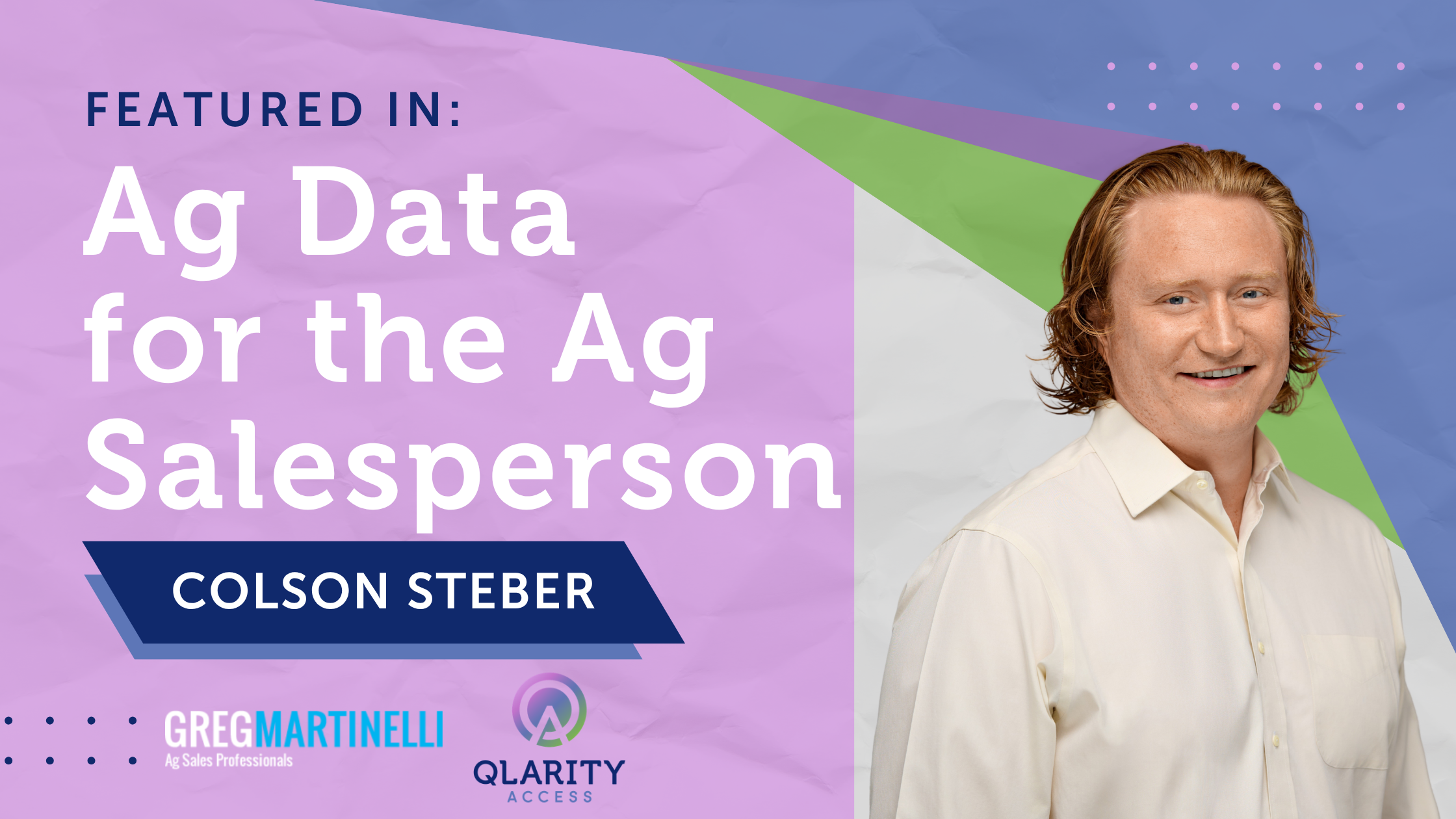
Colson Steber, co-CEO of Qlarity Access and it's Ag Access Division, joined Greg Martinelli to talk about why farmer market data matters to every level of an Ag organization, especially the salesperson.
Greg’s premise is straightforward: better farmer data helps salespeople manage customers and prospects more effectively. This episode breaks down how that data gets collected, why it’s often hard to access, and how sales teams can use it to sell with more confidence than gut feel alone.
From gut feel to evidence in the field
Ag salespeople are trained to move fast: know the product, handle objections, keep momentum.
Greg’s point is that confidence is not the same as clarity. When reps answer “Why do your customers buy from you?” with instinct instead of real data, it turns into gut feel and they’re often wrong.
Colson explains why that matters now. Growers are dealing with information overload and real financial stress, which shifts how decisions get made and how objections show up. In that environment, “your price is too high” can be the quickest way to pause a decision, even when the real issue is risk and pressure.
This isn’t about replacing relationships. It’s about adding farmer data so sales teams can sell with evidence.
The big picture problem: Ag data is siloed
Colson’s point is simple: Ag data is everywhere, but it rarely lives in one place. Data and data aggregation are extremely siloed, so even strong organizations struggle to connect what they have into something consistently usable.
Even when companies can pull their internal data together, matching it with other verified, high-quality data is still extremely challenging.
That’s where Colson positions primary research and why Ag Access exists: go out, get answers directly, then bring the human feedback, needs, and opinions back into the data stream so teams can validate assumptions and decide what to do next.
Why farmer data is elusive and how Ag Access gets it
Farmer data is difficult to do well because it requires two things at once: access to the right people and responses you can trust. Reaching producers at scale is hard. Getting consistent, decision-ready input is even harder.
Colson explains that Ag Access addresses this by building an engaged research community and creating a clear exchange of value for participation, which helps sustain response quality over time.
He also points to scale as a differentiator. The Ag Access Community has 400,000+ ag-sector contacts, and 100,000+ people completed research with them in the past year. That reach helps them match studies to the right respondent types and produce patterns that reflect the market, including segmentation work when needed.
What makes the output usable is the foundation: anonymity supports candid responses, large samples strengthen confidence, and the research process is designed to produce results teams can act on.
What this changes for sales teams: targeting, messaging, and objections
Greg frames farmer data as a practical tool for the day-to-day work of selling: manage customers better and find better prospects. Colson builds on that by connecting research to decisions teams make across go-to-market, not just analytics.
In the field, the biggest win is less uncertainty. When reps know what different operations prioritize and what slows decisions down, they can focus on the right accounts and respond to objections with more precision.
That shows up in three practical ways:
- Targeting: better prospect lists and territory focus, based on how buyers actually decide, not just who’s loudest or most familiar.
- Messaging: clearer value stories that match what customers say they care about, which helps shorten cycles and reduce “nice meeting you” stalls.
- Objections: treating “price” as a surface signal when the underlying driver is overload, pressure, or risk, so the next question gets smarter.
The shift: getting insights into sales, and meeting producers where they are
Two things are changing at the same time in agribusiness, and they reinforce each other.
First, Colson says more agribusinesses are building internal teams to manage research and disseminate insights across the organization. The goal is not to archive reports. It’s to translate findings into something sales can use.
Second, the old tech adoption debate has flipped. Ten years ago, the question was whether farmers would adopt technology at all. Now, producers are far more tech savvy, and our team sees it in behavior: 70%+ of surveys are completed on smartphones, often from a truck or tractor cab.
How sales teams win with these shifts
The advantage goes to teams that connect these shifts. Insights have to move from research output to strategic decisions, and they have to be activated upon in formats that match how producers live and work today. When companies do that well, sales get more than interesting data. They get practical direction they can apply to customer conversations, territory focus, and how they position value in a noisy market.
This episode is a useful reminder that better selling doesn’t start with better talk tracks. It starts with clearer inputs, shared across the business, and translated into actions the field can use.
Listen to the full conversation with Greg Martinelli and Colson Steber here.